


Queen Victoria and Her Heirs

Let’s start at the very beginning, a very good place to start…OK, it’s not really the beginning. But Queen Victoria is a good place to start when it comes to untangling all the threads leading to who ruled Great Britain and its dominions at the start of The Windsor Affair.
Victoria became Queen of England at the tender age of eighteen because of the disastrous offspring of George III. Mad King George’s heirs had a tough time producing legitimate children, although they were swell at siring illegitimate ones! With the death, in 1817, of the Prince of Wales’s daughter, the only legitimate grandchild of George III, the race was on for a legitimate heir to the throne. George III died in 1820, leaving four sons who were in the line of succession, but no legitimate grandchildren. Victoria’s father was the youngest of these sons, the Duke of Kent; after he hastily married Princess Victoria of Saxe-Coburg, a widow with two children, they produced Victoria. Victoria became the only surviving legitimate grandchild of George III and so, after the deaths of her uncles and father, she came to the throne.
Victoria married her cousin Prince Albert of Saxe-Coburg and Gotha. They had a happy marriage, had nine children who all survived into adulthood, and those children married into other royal families of Europe.

Their oldest son, Albert, became Edward VII upon Victoria’s death in 1901. Edward and his wife, the former Princess Alexandra of Denmark, had six children, five of whom survived into adulthood.

Albert Victor on the left. Does he look like a murderer?
Edward’s oldest son, Prince Albert Victor, was his heir and before her death, Queen Victoria decided he should marry an English princess instead of a foreign one—something that hadn’t happened for generations. So Albert Victor became engaged to Princess May of Teck, another descendent of George III.
There were rumors at the time that Prince Albert Victor was the real Jack the Ripper, although this probably isn’t true. It is true that he was a strange young man, mentally and psychologically immature, and most thought he would be a disastrous king. Fortunately for them, he died, and his younger brother George inherited his place in the succession and also, his intended bride.
Upon Edward VII’s death, George and May became King George V and Queen Mary.

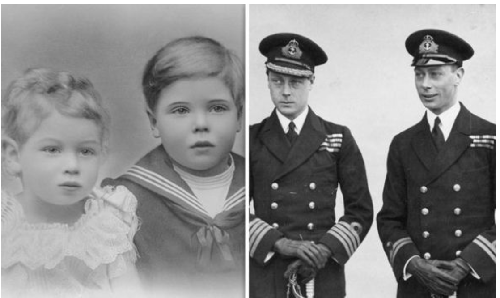
It’s well documented that George V was a very remote, stern father with an explosive temper, and Queen Mary a remote mother who did not like infants at all. As was common for the time, their children were all cared for by nannies and later governesses. Initially, David and Bertie were in the care of a mentally disturbed nanny who abused them psychologically, physically, and perhaps sexually. This went on for a couple of years until another nanny alerted Queen Mary. The effects of this upon those tiny princes, as they grew into troubled adults, can’t be calculated.
I’ve Danced with a Man, Who’s Danced with a Girl, Who’s Danced with the Prince of Wales
World War I greatly impacted the royal family, especially since the grandsons of Queen Victoria were on opposite sides of it. (Kaiser Wilhelm was the son of Princess Victoria, the eldest child of Queen Victoria, and of course King George V was the son of Victoria’s heir Edward VII.) King George V and his wife officially changed their name from the Royal House of Saxe-Coburg and Gotha to the Royal House of Windsor in order to distance themselves from their very German origins and relations.
During the war the young and very popular Prince of Wales, David, begged to be allowed to serve on the front lines but the government forbade him. His younger brother, Bertie, did serve in the Royal Navy on a battleship and saw battle.

Before World War I it was expected that David would marry a proper royal princess. But World War I did away with many of the royal families of Europe. Too, there was a more liberal attitude after the war, so for the first time the heir to the throne could have married a suitable (virgin) commoner (from the aristocracy).
His younger brother Bertie did marry an aristocratic commoner. It was the first time in centuries that had happened. The Duke of York—Bertie—married Elizabeth Bowes-Lyon in 1923. The marriage was very popular.

Meanwhile, dashing David, the Prince of Wales, refused to settle down. Hugely popular with the public—his parents sent him on several world tours to bolster the idea of the royal family in the aftermath of the war—he enjoyed the playboy life. His crowd was the “in” crowd, and he fit right in with the modern times of the Roaring Twenties.

He also seemed to favor married women, much to the consternation of his parents. He had two long-time mistresses, both married to other men. The first was Freda Dudley-Ward, a British aristocrat. They were involved from 1918 to 1929; it was Freda who helped him decorate his beloved Fort Belvedere, his private home on the grounds of the Windsor estate.
In 1929, David turned to a twice-married American, Lady Thelma Furness (she was married to a British lord at the time). It was Thelma (who was the twin sister of Gloria Morgan, the mother of Gloria Vanderbilt) who, sometime around 1931, introduced David to her good friend, Wallis Simpson—
Another married American.
Devoted Bertie
While George V was alive, the person who was second in line to the throne was his second son, Bertie, the Duke of York. (Fun fact—dukedoms are handed out by monarchs to their heirs on rather a willy-nilly basis. Other than the heir to the throne always inheriting the titles Prince or Princess of Wales and Duke or Duchess of Rothesay and Cornwall, the other titles are at the whim of the monarch.)

Bertie, however, was no one’s ideal of a king; he wasn’t suited for a very public role. He had suffered the most at the hands of the abusive nanny; she apparently almost starved him to death in her mad devotion to David. He was also naturally left-handed but, in the custom of the time, was forced to learn how to make his right hand the dominant one. All this combined to make him physically frail—he suffered from digestive issues and also from nervous tics. And he famously had a prominent stutter that caused him to recoil from the spotlight. He was self-effacing, shy, but had a surprising determination that was on full display when he pursued Lady Elizabeth Bowes-Lyon. He asked for her hand not once, not twice, but three times; the third time was the charm and she accepted.
Their marriage developed into a true love match; she supported him through his various ailments and helped him curb the explosive temper he’d inherited from his father. It was Elizabeth who found him a speech therapist to help him with his stutter because, as a royal prince, he couldn’t get out of making speeches now and then. Still, for the most part, the two of them were happy being behind the scenes. Bertie was never going to inherit the throne, they soon had two darling little girls, Elizabeth (Lilibet) and Margaret Rose, and theirs was a very privileged but cozy, domestic life.

They never dreamed that one day it would end.
That Woman

Her father, Teakle Wallis Warfield, died when she was only a few months old. She was named for him; her birth name was Bessie Wallis Warfield and she was called Bessie Wallis (sometimes spelled as Bessiewallis) as a child. As soon as she could, she declared she would no longer go by “Bessie Wallis” as it reminded her of a cow. She was Wallis from then on.
Her mother was dependent on her late husband’s older brother, Solomon Warfield, for any kind of income and shelter. Things were very difficult in the Warfield family home where Wallis and her mother, Alice, were basically unwanted boarders. Throughout her childhood, while her mother tried various ways to support her, including operating a boarding house and marrying again, Wallis had to return time after time to her Uncle Sol. He had to grant permission for her to go to a posh school, to buy appropriate clothes, and to have a debutante season like other girls from prominent Baltimore families.

In 1916, when she was barely twenty, Wallis went to visit a cousin whose husband was commander of a Naval aviation base in Pensacola, Florida. There she met a tall, handsome pilot named Earl Winfield Spencer, Jr. They quickly married and Wallis became a Navy wife, following her husband from base to base where he trained pilots for World War I. The marriage was not a success; Win was an alcoholic and abusive to Wallis. There were no children. Modern biographers suspect Wallis was born with an intersex condition called Androgen Insensitivity Syndrome, which made her unable to have children and contributed to her startling physical appearance—extremely slim with some masculine features.
Wallis eventually divorced Win Spencer and soon became involved with a married man, Ernest Simpson. Simpson was the son of an American mother and British father and was based in London where he ran the family shipping business. Simpson divorced his wife and married Wallis; they were soon up-and-coming socialites in London and became part of the Prince of Wales’s circle due to Wallis’s friendship with Thelma Furness.
Simpson was a very typical British man and apparently, at least at first, had little problem with his wife’s affair with the heir to the throne. He benefitted from this in his business. And had the prince been content to keep Wallis as his mistress, all would have been well.
But David had different ideas and soon the monarchy was in peril as the Abdication Crisis, as it became known, gripped the nation.
Only one member of the Royal Family, it seemed, remained unruffled by all the chaos—Elizabeth Bowes-Lyon.
The Smiling Duchess

Lady Elizabeth Angela Marguerite Bowes-Lyon was born in 1900. The exact location of her birth remains unknown; even her parents couldn’t recall it. She was the ninth of ten children born to Claude Bowes-Lyon, Lord Glamis and later the Earl of Strathmore, a Scottish peerage, and Cecilia Cavendish-Bentnick.
One of her ancestral homes was Glamis Castle, the setting for Shakespeare’s Macbeth; a castle full of ghost stories and rumors that it was haunted. Despite this gloomy setting Elizabeth’s was a charmed childhood; being the youngest—by quite a few years—daughter she was spoiled and cossetted and her family life, unlike that of her future husband’s, was warm and full of love.
World War I, however, brought tragedy to the Bowes-Lyon family. Having already lost one of her brothers as a child, Elizabeth also lost her elder brother, Fergus, who was killed in action while another brother was a prisoner of war. Glamis Castle was turned into a convalescence home for wounded soldiers and Elizabeth—much admired for her vivacity and ability to charm the convalescing soldiers—became close to many of the wounded, only to see them return to the front where they were often killed. She grew up very quickly during the war.

After the war was over she was formally presented to the King and Queen, as all girls of her age and breeding were, and she “came out.” It was a debutante dance where the Duke of York, Prince Bertie, first glimpsed her (although they had met as children, neither remembered it). He was besotted and almost immediately proposed but Elizabeth refused. She seemed to have reservations about becoming a member of the royal family, even if her proposed husband would never reign. She understood how those who married into the Windsors tended to be swallowed up and forced to live a very restricted, and public, life.
However, she was touched by Bertie’s gentle courage and determination as he kept pursuing her and eventually said yes. They were married on April 26, 1923, at Westminster Abbey. Elizabeth charmed the British people as she’d charmed all those convalescing soldiers; always smiling—she was soon nicknamed “The Smiling Duchess”—never perturbed, never ruffled.
During the wedding at the Abbey, Elizabeth spontaneously decided to lay her wedding bouquet upon the tomb of the Unknown Soldier in honor of her fallen brother Fergus. This has become a tradition for all royal brides who marry there.
Elizabeth and Bertie soon had two daughters, Elizabeth (called Lilibet by her family and close friends) and Margaret Rose. They were very happy in their simple—for royals, anyway—life together; they did not frequent the nightclubs that David did. While they were fond of him and he was a devoted uncle to their daughters, they were never really in his “set.” They knew and were fond of both Freda Dudley-Ward and Thelma Furness, and met Wallis and Ernest Simpson early on.
But every expectation was that David would eventually settle down with an appropriate young woman and have children of his own. Instead—despite his father, King George V’s, failing health, David became more and more besotted by Mrs. Simpson, and less and less interested in marrying a “suitable” bride. A crisis was building—
And it came to a head when King George V died in January of 1936.
The Year of Three Kings

George V passed away surrounded by his family on January 20, 1936. (His death was hastened by his physician who gave him a lethal dose of morphine as the king was suffering.) David, the debonair Prince of Wales, was now King Edward VIII and Bertie, the Duke of York, was the heir.
Still, no one thought that Bertie would ever become king. David was young—not yet forty—and would presumably marry someone younger, of child-bearing age, now that he was king.
But his father’s death seemed to deepen David’s obsessive attraction to the married Wallis. Now he started urging her and her husband, Ernest, to divorce; he kept claiming he would not be crowned without Wallis by his side.
The government became alarmed by his behavior, and by Wallis and David’s more and more public sightings including a lengthy vacation in the Mediterranean. The foreign press first became aware of the romance during this trip; there were photographs taken of the king and the married American in rather scandalous situations. But none were published in Great Britain or Scotland; Lord Beaverbrook, the leading press baron of the time and the owner of the Daily Express, among others, succeeded in persuading his fellow news moguls to kill any articles or photographs of the couple. There was a press blackout for a time, but it couldn’t last forever.
Wallis was finally persuaded by David to file for divorce in the fall of 1936; the public soon became aware of the scandal and by December of 1936 Wallis was forced to flee Great Britain, fearful for her life.
The government was firmly against the king’s insistence that he be allowed to marry a twice-divorced American. Any monarch is automatically the head of the Church of England which, at the time, did not acknowledge divorce. The government was very Conservative and it was alarmed by both David’s negligence to his duties as he pursued Wallis, and David’s more liberal ideas of how he would reign.
The king had some allies including Winston Churchill, but none thought he should marry Wallis. Although they would have been fine had he kept her as a mistress on the side after he appropriately married!
Meanwhile Bertie and Elizabeth were growing more and more alarmed as talk of an abdication took hold. It was unprecedented; no modern monarch had ever willingly given up his throne.
But on December 11th, 1936, that’s exactly what King Edward VIII—David—did when he gave his famous radio speech declaring he was unable to govern “without the help and support of the woman I love.”
Soon David left England—never to be able to return for more than a few days at a time, although he didn’t know it—and Bertie became George VI.
Elizabeth Bowes-Lyon was queen—and her daughter Elizabeth was now heir to the throne. The abdication changed history in so many ways. There would have been no Elizabeth II, Britain’s longest-reigning monarch. And World War II might have ended very differently had it not been for King George VI and Queen Elizabeth, the consort.

World War II and After
After their marriage in 1937, Wallis and David—now styled the Duke and Duchess of Windsor—traveled to Nazi Germany as part of an unofficial tour. But to the world, the former king still represented England. And when the current king and queen saw photos of Wallis and David smiling with Adolf Hitler, they were outraged.

The Windsors admired Hitler and didn’t admire war. David in particular remembered the carnage of World War I and spoke passionately of not repeating it—to the point where he was on the side of appeasing Hitler at all costs. Even while London was being bombed by the Luftwaffe.
We now know, thanks to the Marburg Files, that there was a Nazi plan to persuade the Duke of Windsor to officially join the side of the Nazis and urge Britain to surrender. There was also a plan to install the Duke and Duchess of Windsor as puppet king and queen when that happened. While there’s no record that the duke and duchess officially agreed to these plans, there is record of allegations that the duke encouraged the Nazis to bomb England relentlessly in order to achieve a quick end to the war.
These files were discovered by Americans in Germany during the last days of the war and brought to the British government. The king and queen were made aware of them. But the files were kept from the public until 1957 (further files were released in 1996).
While others who collaborated with the Nazis were imprisoned and even executed, the Duke and Duchess of Windsor were not. The price they paid was permanent exile from England. Up until the end of the war, the Windsors expected they would be allowed to return to England to live, and the former king continually petitioned for an official government job—and salary.
After the Marburg Files, King George VI—and the Queen Consort, Elizabeth—made it clear this would never happen.
So the Windsors were left to live a frivolous, empty life in France. While Bertie and Elizabeth, after being the courageous leaders of a nation at war—Hitler said that Elizabeth was “the most dangerous woman in Europe” due to her unflappable charm—were more beloved by the British people than ever.

When King George VI died in 1953, from lung cancer, his widow, Elizabeth Bowes-Lyon, forever blamed his older brother and, in particular, That Woman (she refused to call Wallis by name for most of her long life) for his premature death.
Elizabeth Bowes-Lyon lived another fifty years; she outlived everyone else who was involved in the 1936 Abdication Crisis. She was surrounded by her children and grandchildren and beloved by the British public, remaining a working royal until the very end.
Wallis Simpson had a much sadder ending. After the Duke of Windsor died in 1972 (like his brother and father, the duke died of health issues related to a heavy smoking habit), Wallis became a recluse in their home in Paris. She began exhibiting signs of dementia possibly as early as the duke’s funeral; she had several falls and broke her hip twice. Eventually she was bedridden while her French lawyer, Suzanne Blum, assumed power of attorney and became her jailer. Blum began selling items owned by the Windsors and pocketing the money; she forbade visitors from seeing Wallis who, in 1980, lost her ability to speak.
Wallis died in 1986, alone except for paid caretakers.
Who Wore it Best?
Wallis and Elizabeth had very different tastes in fashion. Wallis dieted religiously—possibly to the point of an eating disorder, possibly shared by her husband—and wore the trendiest designers of the time: Schiaparelli, Chanel, Mainbocher (who designed her wedding dress).

She favored sleek styles that accented her slim figure, and her jewelry collection was legendary.


She also very publicly made fun of her rival, Elizabeth Bowes-Lyon. The Windsors’ nickname for Elizabeth was “Cookie,” partly a reference to her figure (this was an era when body shaming was common). Elizabeth dressed very typical of her time and breeding; rather dowdy country woman kinds of clothes. Her wedding dress was designed by her mother-in-law’s dressmaker (and to be honest, it’s a horror).

It was a triumph.


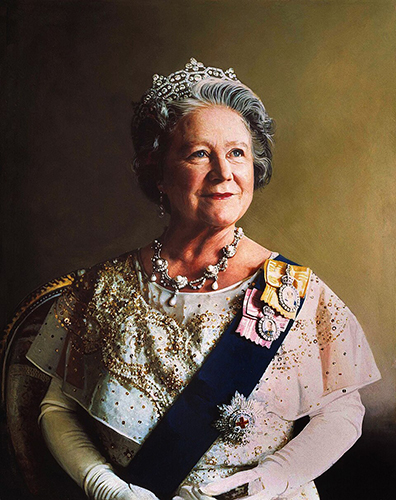
Throughout her life the Queen Mother, as she became upon her husband’s death, remained devoted to the flounces and ruffles of the past. Unlike Wallis, Elizabeth was never going to follow or set a trend.
Corgis!!
Before they were king and queen, the Duke and Duchess of York gave their daughter Lilibet her first corgi, named Dookie. Soon Dookie was joined by Jane—and a legend was born.

When their daughter turned 18 in 1944, she was given another corgi named Susan. Susan became the matriarch of all the future queen’s corgis—a total of 30 during her long reign.
Pugs!!
While corgis are forever associated with Queen Elizabeth II, so pugs are with the Duke and Duchess of Windsor.
Actually, it was the duke’s great-grandmother, Queen Victoria, who was a fan of the breed.

While Bertie gravitated toward corgis, his older brother David fell for pugs. While Wallis wasn’t much of an animal fan before she met David, she became an ardent lover of their famous pugs. They had as many as eleven pugs at a time, all of whom were fed from silver bowls. The jet-setting Windsors always traveled with a couple of pugs and even brought them to dinner parties. And they famously owned anything that had a pug on it, including this collection of pug pillows.
One of their staff said their pugs were the children the Windsors never had.
